
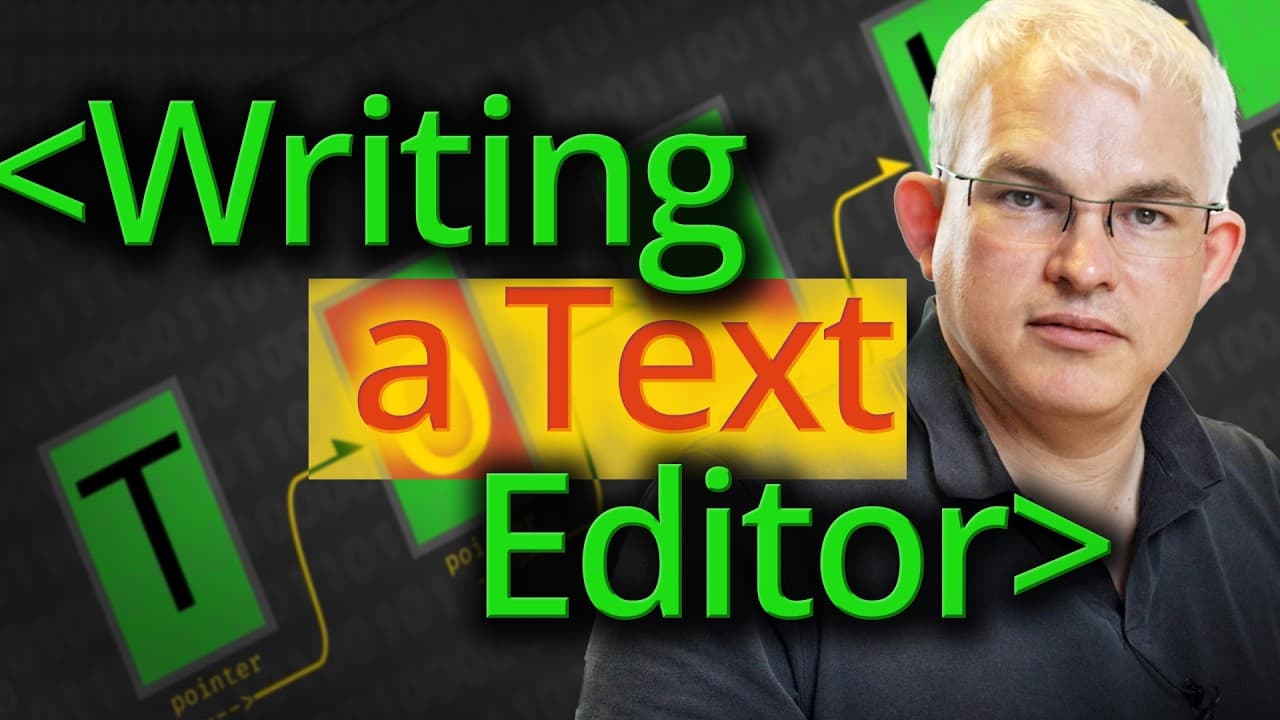
New Video from @Computerphile Explores Text Editors
In this video, Computerphile delves into a often overlooked but fundamental topic: text editors. Although these tools may seem simple and ubiquitous, their design hides surprising complexity. The video begins by defining what it means to edit text, highlighting basic operations such as inserting, deleting, and replacing characters. These operations, though simple in appearance, can become inefficient if the underlying data structures are not properly designed.
One of the first approaches discussed is the use of strings to represent text. However, this method has drawbacks, including memory fragmentation and the slowness of concatenation operations, especially in languages where strings are immutable. A more efficient alternative is the use of an array of characters, which allows for quick insertions and deletions at the end of the document. However, this method becomes inefficient for insertions and deletions in the middle of the document, as it requires moving all subsequent characters.
To overcome these limitations, the video explores the use of linked lists. Each character is represented by an element in the list, with pointers to the next and previous elements. This structure allows for quick insertions and deletions, but at the cost of increased memory consumption, as each character requires additional pointers. A hybrid solution is to use linked lists of lines, as the VI text editor does, which allows for more efficient manipulation of text blocks.
The video then introduces the concept of a "gap buffer," a data structure that optimizes editing operations by considering how users interact with text. The gap buffer maintains an empty space (gap) in the document, allowing for quick insertions at that location. When the user wants to insert text elsewhere, the gap is moved to that new position, requiring only a single copy operation. This method is particularly effective for typical text editing, where users often add several characters at a time.
Finally, the video discusses the differences between text editors and word processors. Text editors are generally used for source code and plain text, while word processors offer additional features such as formatting and layout. Although word processors may use more complex data structures, the basic principle remains the same: avoiding unnecessary character copies to improve efficiency.
In conclusion, this video offers a fascinating dive into the inner workings of text editors, showing how seemingly simple design choices can have a significant impact on efficiency and performance. For those who want to learn more, the video is available at the following address: https://www.youtube.com/watch?v=g2hiVp6oPZc