
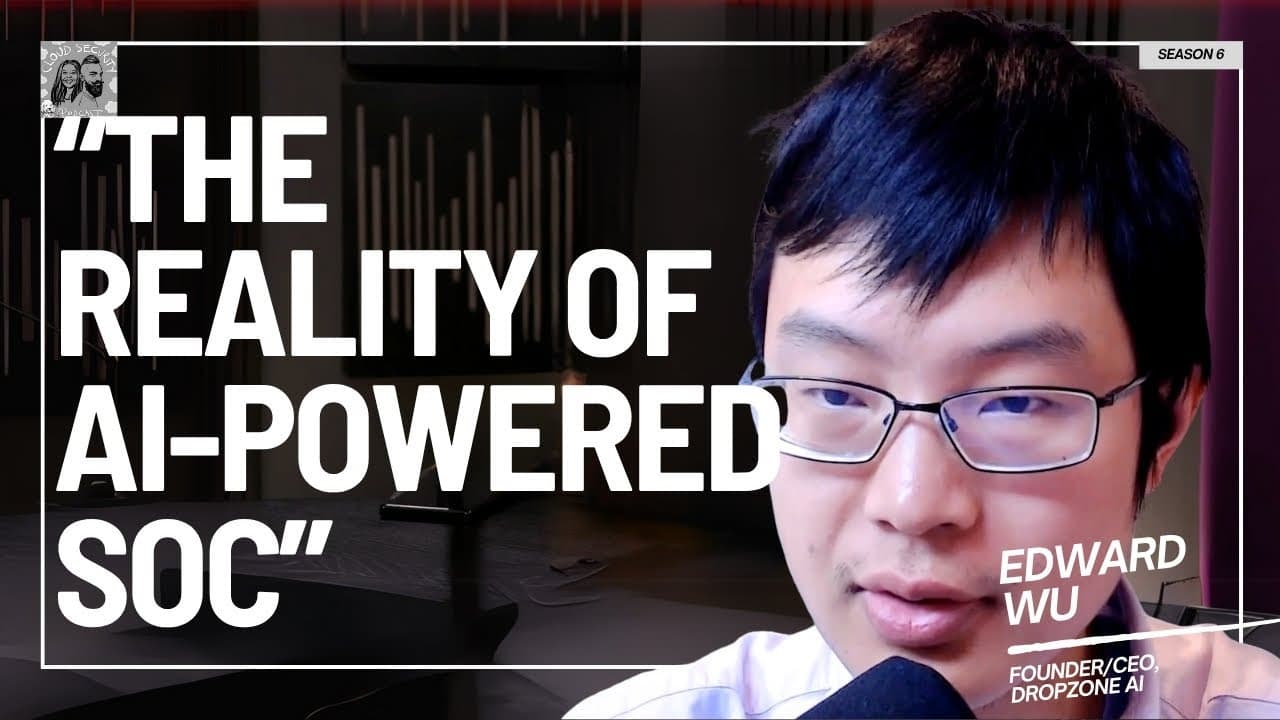
New Video from @CloudSecurityPodcast: Exploring AI in Cybersecurity Operations
In this video, the Cloud Security Podcast explores the field of cybersecurity and the impact of artificial intelligence (AI) on security operations (SOC). The main guest is Edward Wu, founder and CEO of Drop Zone AI, a Seattle-based cybersecurity startup that uses large language models to create AI security agents.
Main topics discussed:
-
Definition of Agentic SOC: Edward Wu defines an agentic SOC as a security operations center where human security engineers and analysts work alongside AI agents. He compares AI agents to foot soldiers, while humans act as generals, directing the AI agents and handling complex missions that the agents cannot manage.
-
Limitations of SOAR Technologies: SOAR (Security Orchestration, Automation, and Response) technologies use decision tree-based playbooks, which limits their ability to fully automate alert investigations. Security alerts often require improvisation and dynamic planning, which AI agents can better handle due to their dynamic planning capabilities.
-
Role of AI in SOCs: AI is not intended to replace humans but to augment them. AI agents can take over repetitive and manual tasks, allowing human analysts to focus on more interesting and intellectually stimulating projects.
-
Challenges in Building AI Agents: Building AI agents in-house is complex and requires meticulous orchestration of many large language model invocations. Additionally, integrating these agents with various cybersecurity tools and adapting to organization-specific data is a major challenge.
-
Impact of AI on Security Metrics: AI can significantly reduce the mean time to resolution (MTTR) of security alerts, often to just a few minutes, which is impossible to achieve with human teams alone. This also increases alert coverage by examining alerts that would otherwise be ignored.
-
Evolution of Threats and Adversarial Use of AI: Although the volume of security alerts is increasing, attackers have not yet massively adopted AI because they can already succeed without it. However, AI techniques are used to improve phishing emails and outbound sales.
-
Current Use of AI in SOCs: SOC teams already use tools like GitHub Copilot and ChatGPT for specific tasks such as interpreting PowerShell scripts, OCR, and writing reports.
-
Maturity and Adoption of AI in SOCs: Edward Wu describes four levels of maturity for AI adoption in SOCs, ranging from using AI for specific tasks to its full integration as a team member with genius-level intelligence.
-
Transparency and Trust in AI: Transparency is essential for building trust in AI agents. Systems must provide clear chains of evidence and metadata to justify their conclusions. Trust is built over time and experience.
-
Impact of AI on Other Areas of Cybersecurity: AI can automate many manual and repetitive tasks in vulnerability management, GRC, patching, reading threat actor reports, code review, and penetration testing.
-
Data Privacy Concerns: Companies must ensure that customer data is not used to train models without consent. Drop Zone AI uses a single-tenant architecture and de-identified telemetry to improve its systems without compromising data privacy.
-
Future Evolution of Roles in SOCs: Level 1 roles in SOCs will likely be replaced by software, but current analysts can evolve into more interesting and stimulating roles in cybersecurity.
Conclusion:
The video concludes with a discussion about Edward Wu's hobbies, including sim racing and video games, as well as his restaurant recommendations. Edward Wu emphasizes the importance of transparency and trust in adopting AI in SOCs and encourages security teams to explore the possibilities offered by AI to improve their operations.
To learn more, watch the full video at the following address: https://www.youtube.com/watch?v=XxxJOUQp4xM