
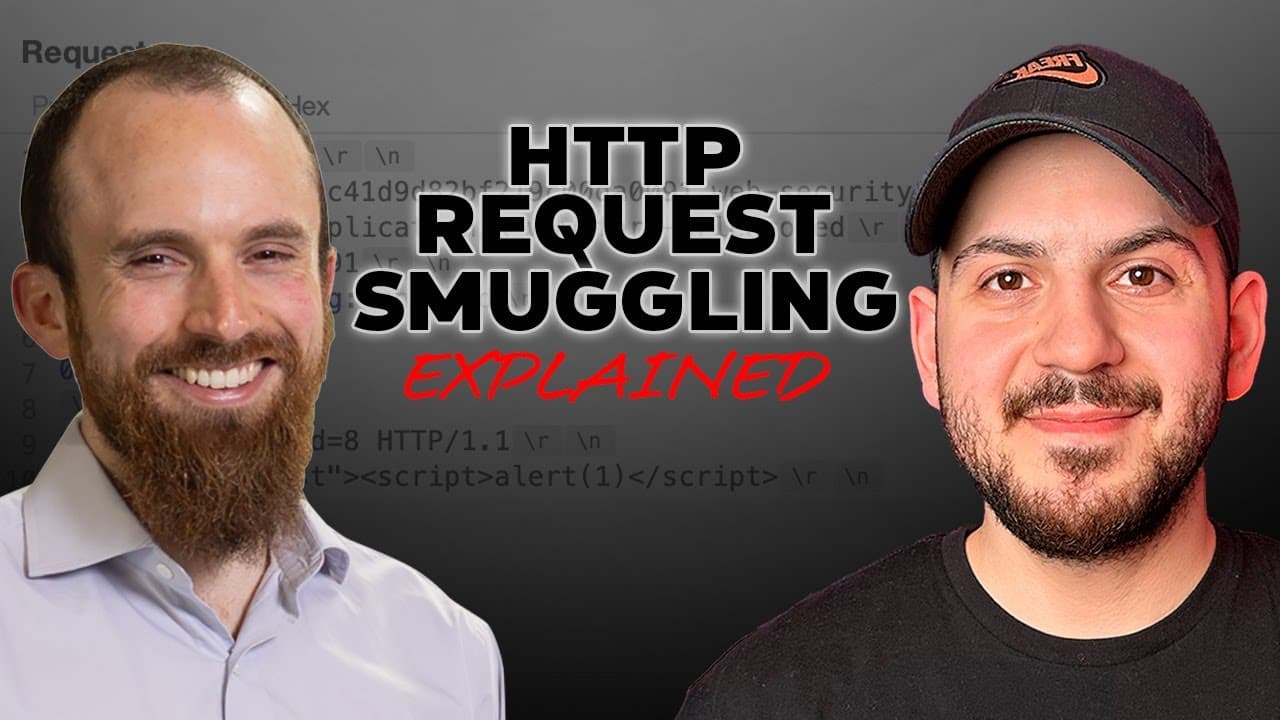
NahamSec Releases New Video on HTTP Request Smuggling
In this video, NahamSec delves into the concept of "HTTP request smuggling," a subtle yet powerful vulnerability that exists between the front-end and back-end of a website. This flaw allows an attacker to hijack sessions, trigger administrative actions, bypass authentication, and even take control of entire domains, all without requiring any interaction from the victim.
To better understand this vulnerability, NahamSec invites James Kettle, a renowned expert in this field. Kettle shares his research methods and insights on HTTP RFCs (Request for Comments), focusing on forgotten features and forbidden actions that can be exploited. He explains that older RFCs, although deprecated, are often still used by servers, creating opportunities for "request smuggling" attacks.
The core of the vulnerability lies in how servers interpret HTTP headers, particularly "Content-Length" and "Transfer-Encoding." When these headers are used together, servers may disagree on the end of a request, creating an opportunity for an attacker to "smuggle" additional data. This technique can be used for attacks such as session hijacking, web cache poisoning, and even generating arbitrary responses.
NahamSec then demonstrates how to identify and exploit this vulnerability using a practical example. He shows how to send requests specifically designed to create a disagreement between the front-end and back-end, allowing additional requests to be smuggled. He uses a Portswigger Academy lab to illustrate how a reflected XSS, normally non-exploitable, can be turned into an exploitable attack through "request smuggling."
The video concludes with a practical demonstration where NahamSec exploits a reflected XSS using the "request smuggling" technique. He shows how to smuggle a request that modifies the victim's user agent, thereby triggering a JavaScript alert. This demonstration highlights the power and subtlety of this vulnerability, as well as its potential for more complex attacks.
In conclusion, "HTTP request smuggling" is a complex but extremely powerful vulnerability that can have devastating implications. Understanding this technique allows security researchers to discover critical flaws and receive substantial rewards in bug bounty programs. For those who want to learn more, NahamSec recommends following James Kettle's research and consulting the resources available on Portswigger Academy.