
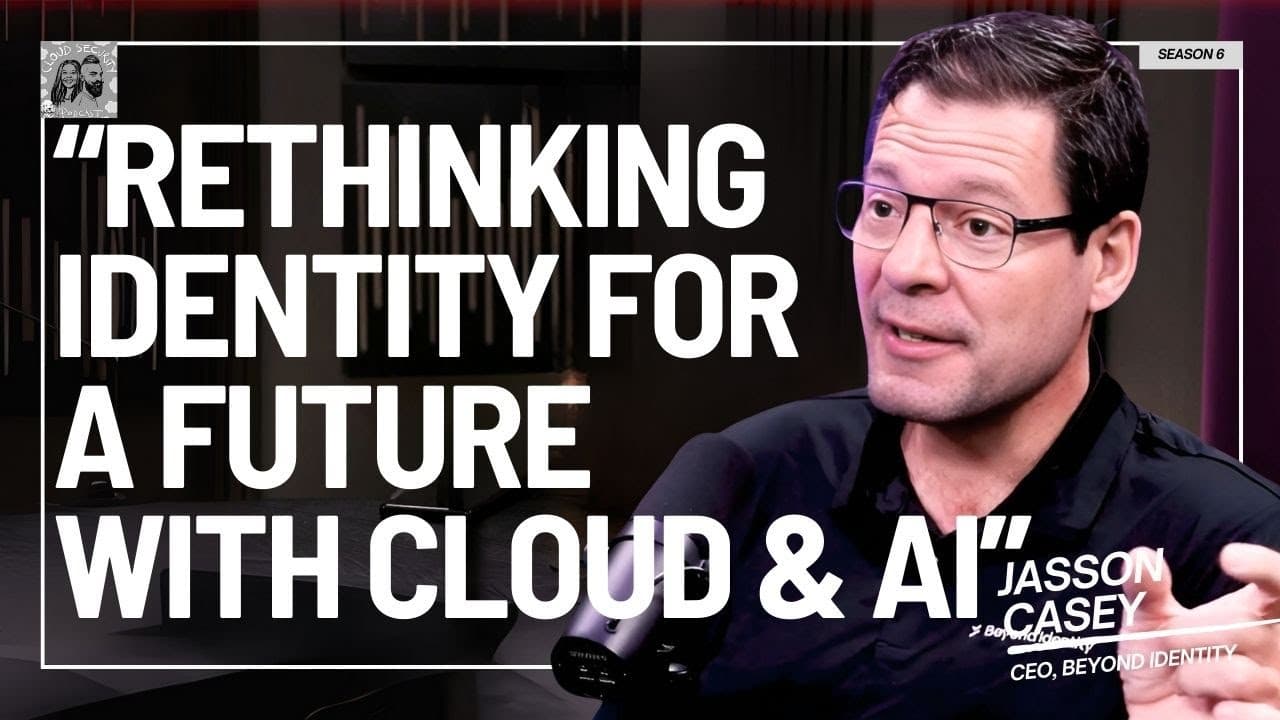
New Video from @CloudSecurityPodcast: Jason Casey Discusses Digital Identity Management Challenges and Solutions
In this video, Jason Casey, co-founder and CEO of Beyond Identity, discusses the current and future challenges of digital identity management, focusing on security issues and potential solutions. The conversation covers several key topics, including multi-factor authentication (MFA), hardware-bound identities, and the implications of artificial intelligence (AI) on identity security.
Current Issues in Identity Management
Jason begins by explaining why current identity solutions are often insufficient. He emphasizes that identity products are often treated as productivity tools rather than security tools. This means they are designed to facilitate access and use, but not necessarily to ensure security. For example, traditional methods such as passwords and TOTP (Time-based One-Time Password) tokens are vulnerable to attacks because they rely on secrets that can be intercepted or copied.
Hardware-Based Solutions
To address these issues, Jason proposes hardware-bound identity solutions. He explains that most modern devices, including smartphones and laptops, are equipped with security coprocessors like Apple's secure enclaves or TPM (Trusted Platform Module) modules. These components allow the creation of asymmetric key pairs that can never leave the hardware, making the secrets impossible to steal or copy. This approach is similar to that used in secure mobile payments like Apple Pay and Google Pay.
AI Challenges and Opportunities
The discussion then turns to the implications of AI on identity security. Jason points out that adversaries are already using AI tools to create very convincing social engineering attacks, such as deepfakes. He explains that AI-based detections are insufficient because they can be bypassed by more advanced AI generators. Instead, he proposes that hardware-bound identities can offer a more robust solution by providing deterministic proof of the user's identity and the integrity of the AI model.
Practical Applications
Jason provides several practical examples where hardware-bound identities can be applied. For instance, in the context of drones used in modern conflicts, hardware-bound identities can help distinguish friendly drones from enemy drones. Additionally, in cloud environments, hardware-bound identities can be used to secure workloads and transactions, ensuring that only authorized users and machines can access sensitive resources.
Conclusion
In conclusion, Jason Casey offers an enlightening perspective on the current challenges of identity management and proposes innovative hardware-based solutions to enhance security. He emphasizes the importance of moving from probabilistic to deterministic solutions to better protect digital identities in an increasingly connected world vulnerable to AI attacks.
To learn more about Beyond Identity and the solutions proposed by Jason Casey, you can visit their website or follow them on social media.