
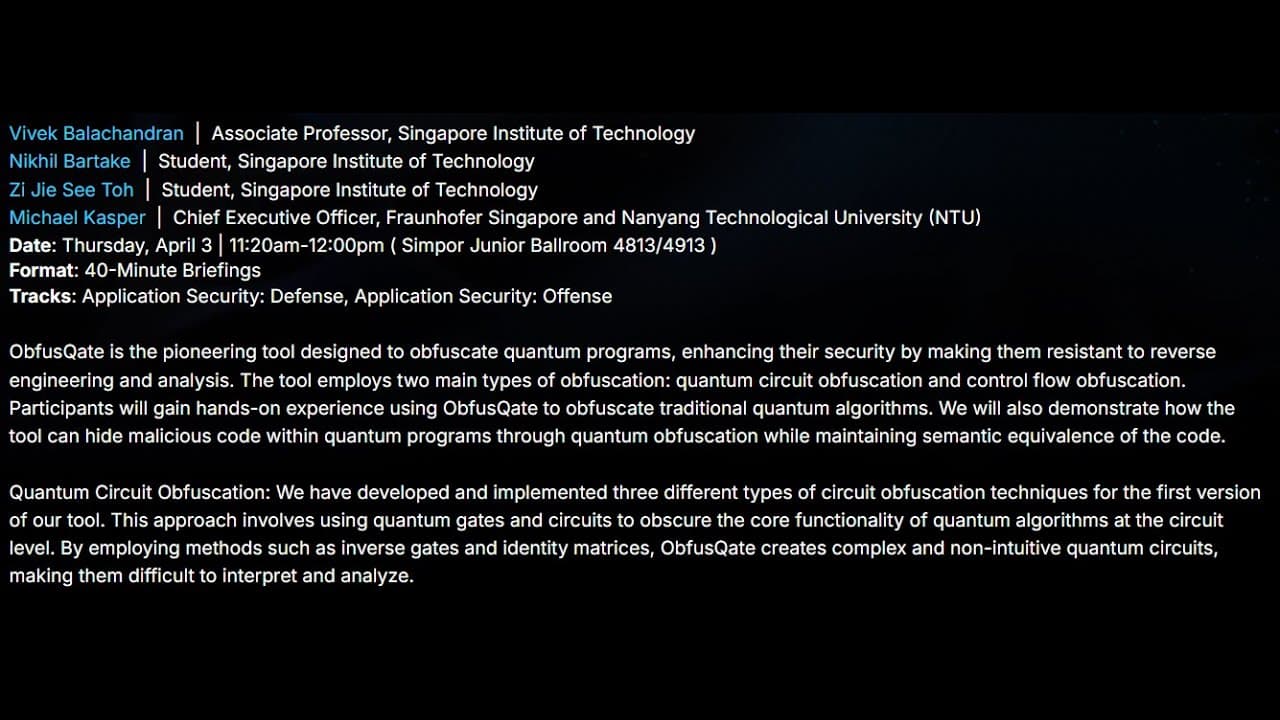
New Video from @BlackHatOfficialYT Introduces "Offiscate" for Quantum Algorithm Protection
In this video, Vive, an associate professor at SIT, presents an innovative tool for protecting quantum algorithms called "Offiscate." He begins by explaining the importance of quantum physics and its impact on various modern technologies, such as nanoscale chips, medical devices, telecommunications, and global positioning systems (GPS). Vive highlights that quantum physics has revolutionized our understanding of the world by introducing concepts such as superposition and entanglement, which allow particles to be in multiple states simultaneously and have correlated effects over large distances.
The video showcases the impressive capabilities of quantum computers compared to classical supercomputers. For example, the supercomputer L Capitan can perform 1,74742 xaflops, equivalent to millions of Nvidia RTX5080 graphics cards working together. However, a quantum computer like Google Quantum Willow can solve a quantum benchmark problem in just 5 seconds, a task that would take L Capitan a quadrillion years to complete. Vive explains that, although these performances are impressive, the problems solved by current quantum computers are not yet of great practical use.
The main objective of the presentation is to discuss the protection of quantum algorithms. Vive introduces Offiscate, a tool aimed at securing quantum algorithms by making them difficult to understand and copy while preserving their functionality. He explains that, since quantum computers are not yet widely accessible, quantum algorithms will likely be run on third-party quantum computers, raising concerns about data security and confidentiality.
Offiscate uses several obfuscation techniques to protect quantum algorithms. Vive describes four circuit-level obfuscation techniques: reverse gate obfuscation, delayed gate obfuscation, composite gate obfuscation, and clock gate obfuscation. These techniques modify the quantum circuit by adding or removing gates without changing the program's meaning, making the circuit more complex and difficult to understand.
In addition to circuit-level obfuscation techniques, Vive presents four code-level obfuscation techniques: simple entanglement obfuscation, variable qubit pair obfuscation, superposition obfuscation, and branching via superposition obfuscation. These techniques add extra branches and useless bytes to the code, protected by quantum challenges, making de-obfuscation difficult without solving these challenges.
Vive demonstrates the use of Offiscate by showing how a simple button can obfuscate quantum code in a few seconds. He emphasizes that, although the tool is primarily designed for defensive purposes, it can also be used for offensive purposes, such as adding malicious code to a quantum program. He mentions that current reverse engineering tools and antivirus software can detect malicious code in a non-obfuscated quantum program but struggle to do so when the code is obfuscated.
In conclusion, Vive stresses the importance of preparing for the future of quantum computing, which could arrive in a few years or a few decades. He encourages programmers and security engineers to start thinking about protecting their quantum algorithms now. Offiscate is available online and can be used via a Docker container for those who prefer not to upload their code to the website.
For more details, you can watch the full video at the following address: https://www.youtube.com/watch?v=5mDNZNGLlsE