
Former Tesla Engineer Launches Open Source Robotics Project
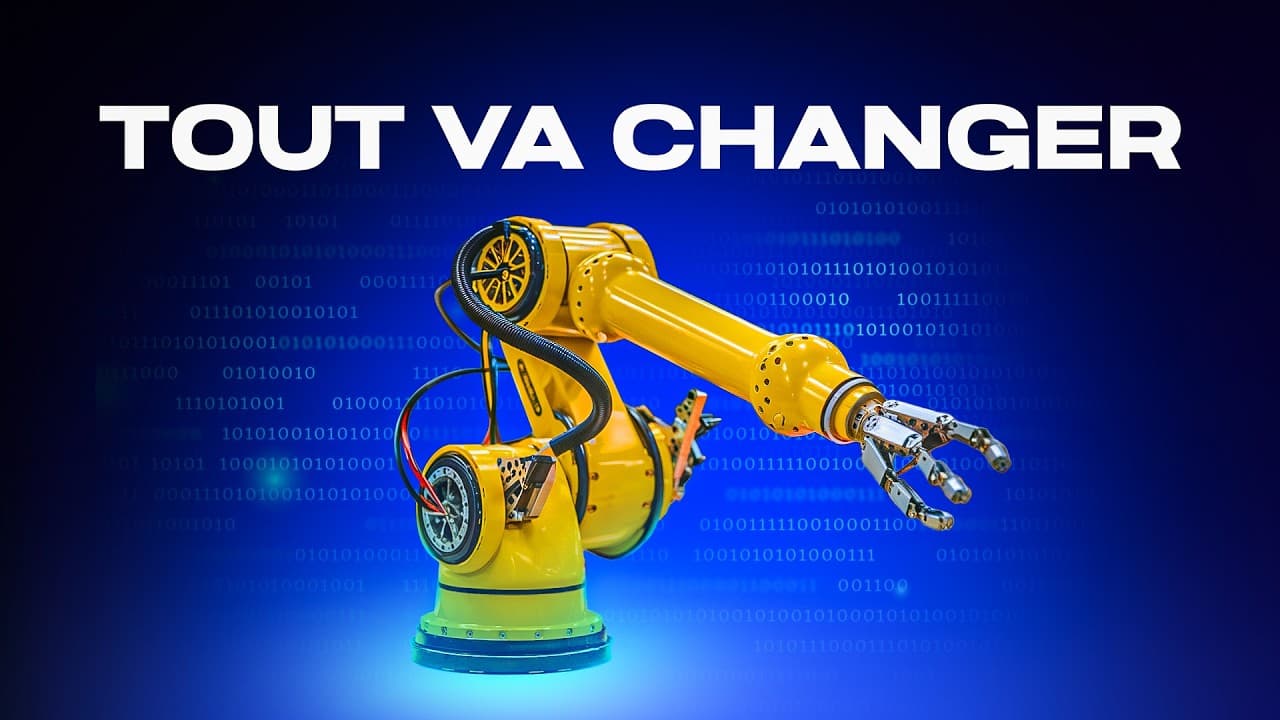
In this video, the main guest is Rémy, a former Tesla engineer who worked on the Optimus project, the company's humanoid robot. Rémy left Silicon Valley to return to France, convinced that robotics is undergoing a revolution. He created the project "Le Robot" at Hugging Face, aiming to develop an open-source robotic arm for only 110 €, using fishing line and a 3D printer. This project could be the key to creating intelligent robots in a more accessible and economical way. Rémy explains that robotics has recently evolved thanks to the learning approach, particularly reinforcement learning in simulation. Unlike traditional methods where robot movements were modeled with physical equations, the new approaches allow robots to learn by themselves by interacting with their environment. This method is more flexible and allows for better generalization of behaviors. One of the major challenges of modern robotics is the collection of training data. Rémy points out that current robots are often specialized in a single task, such as grasping an object or driving a car. However, the goal is to create more general models, capable of understanding and executing a variety of tasks. This requires a massive amount of data, similar to what has been done for language models like ChatGPT. Rémy shares his experience at Tesla, where he worked on the Optimus project. He describes how Elon Musk was very involved and informed about the technical details, which is rare for a CEO of a large company. Rémy left Tesla partly because of the monoculture of Silicon Valley and the quality of life in Europe. Back in France, he proposed the project "Le Robot" to Hugging Face, a Parisian company specializing in AI. The project "Le Robot" aims to make robotics accessible to everyone. The open-source robotic arm can be easily assembled and used to automate simple tasks. Rémy explains that the goal is to create a community open-source database of tasks, allowing everyone to contribute and improve the capabilities of robots. He also mentions other ongoing projects, such as a mobile robot with omnidirectional wheels and a bipedal robot. Rémy discusses the practical implications of these advances. Robots could be used for simple household tasks, such as filling a coffee machine or sorting objects. They could also have applications in disability contexts or for the elderly, improving their daily lives. The project "Le Robot" could also have a significant impact on the industry, making automation more accessible and less costly. In conclusion, this video offers a fascinating glimpse into recent advances in robotics and the challenges ahead. Rémy shows how innovative approaches and open-source projects can democratize access to robotics and open up new possibilities for automation in various fields.