
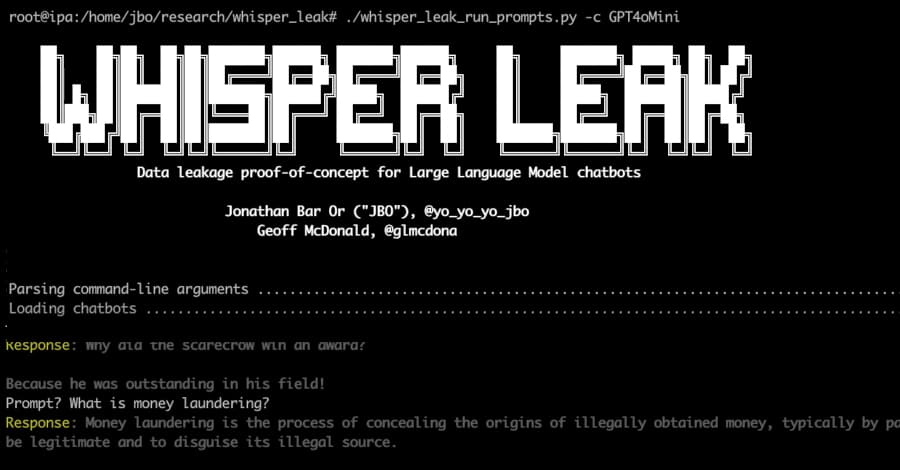
Whisper Leak: Microsoft Reveals New Side-Channel Attack Targeting Language Models
Microsoft has disclosed details of a new side-channel attack named "Whisper Leak," which targets language models remotely. This attack enables a passive adversary, capable of monitoring network traffic, to infer information about the topics of conversation between humans and language models, even when encryption is in place under certain conditions. The leakage of data exchanged in streaming mode between humans and language models could pose significant risks.
Side-channel attacks exploit physical or environmental factors to gather information. In the case of Whisper Leak, the attack focuses on observing network traffic patterns. Despite encryption, the patterns in the traffic can reveal sensitive information about the conversation topics.
The implications of this attack are far-reaching. It underscores the limitations of encryption alone in protecting sensitive information. Cybersecurity professionals must consider additional layers of defense to mitigate such risks. Techniques such as traffic analysis prevention, padding, and constant-time algorithms can help protect against side-channel attacks.
For organizations relying on language models for sensitive communications, this attack highlights the need for robust security measures. Monitoring network traffic for unusual patterns, implementing traffic analysis prevention techniques, and staying updated on emerging threats are crucial steps.
In conclusion, the Whisper Leak attack serves as a reminder that encryption is not a panacea. A defense-in-depth approach, incorporating multiple layers of security, is essential to protect against evolving threats.