
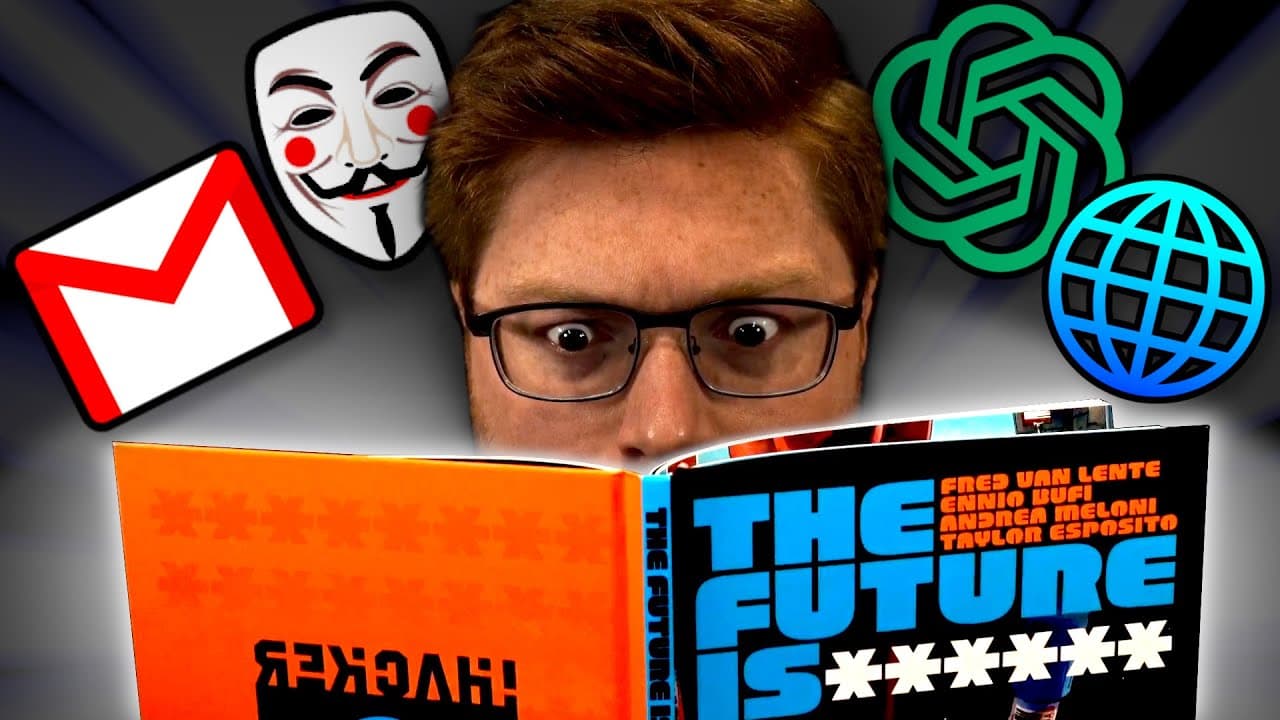
John Hammond Continues CTF Challenges in "The Future Is" Comic Series
In this video, John Hammond continues his exploration of "Capture The Flag" (CTF) challenges integrated into the comic series The Future Is. These challenges, designed to be both fun and educational, allow cybersecurity enthusiasts to train on realistic scenarios while following an engaging storyline. After solving the initial challenges in a previous video, John focuses here on challenges two, three, and four, each presenting different techniques and tools to solve cybersecurity problems.
The second challenge delves into the analysis of a malicious email, a classic phishing attack. The goal is to examine a .eml file (a raw email) received by an employee of a fictional facility in Hawaii, who was tricked into disclosing personal information. John explains how to extract a suspicious attachment from the .eml file, using Linux commands like file to identify the file type and base64 -d to decode the base64-encoded content. The attachment turns out to be a Word document (.docm), a format that can contain malicious macros. To analyze these macros, John uses the tool OLEVBA, a Python utility specialized in extracting and analyzing VBA (Visual Basic for Applications) scripts embedded in Office files. This process reveals the presence of a hidden flag in the code, illustrating how attackers often use macros to execute malicious code without the user's knowledge. This part of the video highlights the importance of vigilance against suspicious emails and the usefulness of tools like OLEVBA to detect potential threats.
The third challenge addresses a more modern and sophisticated concept: the poisoning of AI models. In this scenario, a hero of the story is marked as suspicious by an AI-based security system. The goal is to manipulate the model to reveal a flag without triggering an alert. John demonstrates how to use a prompt injection technique to trick the AI by asking it to systematically do the opposite of its initial instructions. By doing so, he manages to bypass the restrictions and obtain the flag. This part of the video is particularly interesting as it shows how AI systems, despite their power, can be vulnerable to simple manipulations. It also underscores the importance of securing AI models against attacks that exploit their decision-making mechanisms.
The fourth challenge focuses on analyzing network traffic from a pcap (Packet Capture) file, which records communications between a security sensor and a central control system. John uses tools like Wireshark to manually examine the packets, but he prefers TCPFlow to automatically extract data streams and exchanged files. By analyzing the logs, he discovers messages containing integrity violations, where hexadecimal values are hidden within parentheses. By assembling them, he reconstructs the flag, illustrating how attackers can hide information within seemingly innocuous network communications. This part of the video is an excellent example of the importance of forensic network analysis to detect suspicious activities and understand how data can be exfiltrated or manipulated.
Throughout the video, John Hammond adopts a pedagogical approach, explaining each step clearly and providing practical tips to reproduce these techniques in a real environment. Whether analyzing malicious emails, manipulating AI models, or dissecting network captures, the challenges presented offer an excellent opportunity to learn essential cybersecurity skills. These exercises are not just theoretical; they reflect real situations that security professionals face daily. By following these tutorials, viewers can not only improve their technical skills but also develop a better understanding of the tactics used by cybercriminals and methods to counter them.
The video concludes by reminding viewers that the The Future Is series offers several more challenges to explore, each providing a new opportunity to learn and have fun. For those wishing to deepen their knowledge of cybersecurity, these exercises are an ideal gateway to more advanced concepts while remaining accessible to motivated beginners. John Hammond, with his dynamic and engaging style, makes these complex topics accessible and exciting, making this video a valuable resource for anyone interested in computer security.