
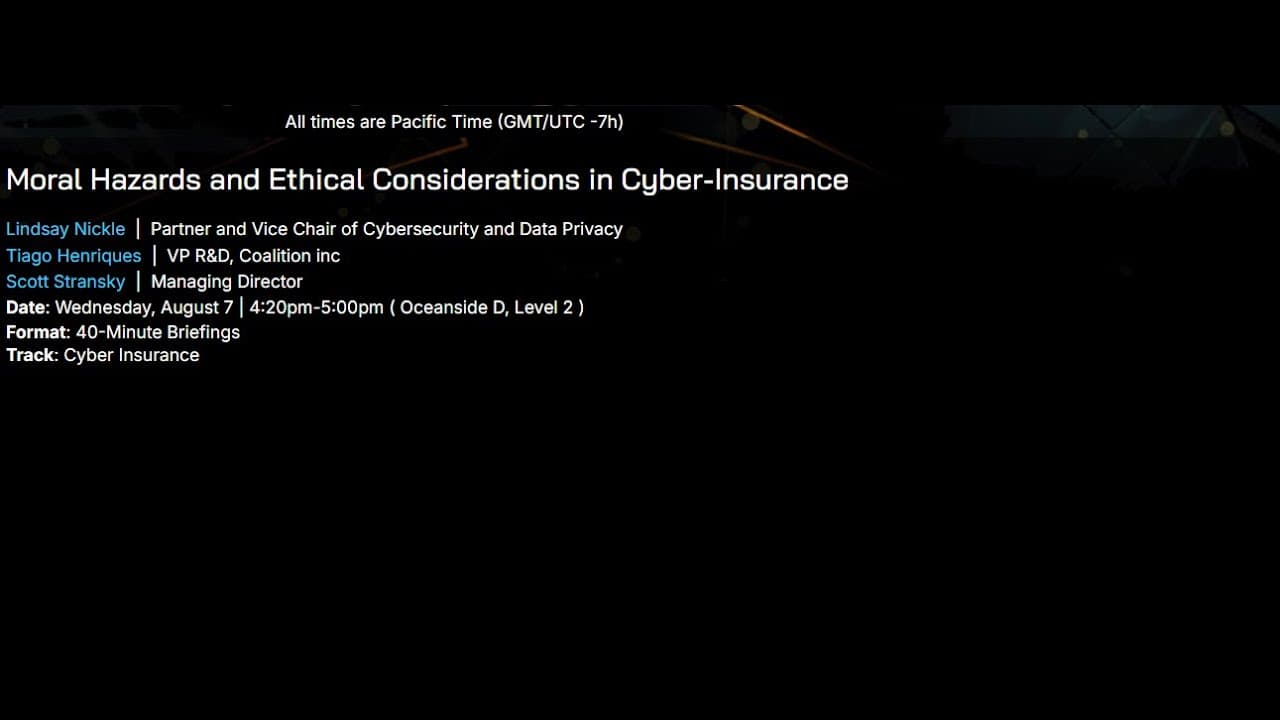
New Video from @BlackHatOfficialYT Discusses Cyber Insurance Challenges and Opportunities
The video features a panel discussion on cyber insurance, led by experts in cybersecurity and insurance. The panel addresses several crucial questions regarding cyber insurance, including whether insurers actually pay claims, if companies invest less in security due to the existence of these insurances, and how subscription questionnaires match the reality of companies' security environments. One of the key points discussed is whether insurers really pay claims in the event of a cyberattack. Lindsay Nickel, a lawyer specializing in cybersecurity incident management, asserts that insurers generally pay claims. She emphasizes that cyber insurance policies offer not only financial coverage but also access to experts and resources to manage incidents. Scott Stransky, from Marsh McLennan, confirms that insurers have an interest in paying valid claims to obtain valuable data on incidents, which helps them improve their risk models. Another important topic is the issue of "moral hazard," that is, the risk that companies will neglect their security controls because they are insured. The panelists agree that cyber insurance should not be an excuse to neglect security. Thiago, VP of Research at Coalition, points out that insurers require minimum security controls to underwrite a policy, such as multi-factor authentication (MFA) and updating security patches. Jeffrey Smith, an insurance broker, adds that companies must invest in security before considering insurance as a last resort. The discussion also addresses the accuracy of subscription questionnaires. Scott Stransky reveals that a recent study showed that up to 80% of the responses regarding multi-factor authentication (MFA) were incorrect, often due to a misunderstanding of the questions. Lindsay Nickel emphasizes the importance of having the right people within the company answer the questions to avoid errors. Thiago mentions that insurers use integrations and external scans to verify the responses of the questionnaires, which helps identify inconsistencies. An interesting point raised by Lindsay Nickel is whether cybercriminals adjust their ransom demands based on the coverage limits of insurances. She explains that cybercriminals do indeed adapt their strategies based on the information they obtain about companies' insurance policies. Thiago adds that cybercriminal groups like Conti have specific playbooks for researching and exploiting information about insurance policies. The video concludes with a discussion on the resources available to help companies determine appropriate amounts of insurance coverage for their suppliers. The panelists recommend working with specialized brokers and using loss calculation tools to assess insurance needs. They also emphasize the importance of internal collaboration to obtain accurate responses to subscription questionnaires. In conclusion, the video provides an in-depth perspective on the challenges and opportunities related to cyber insurance. It highlights the importance of collaboration between different stakeholders, the accuracy of information provided to insurers, and continuous investment in security to minimize risks.