
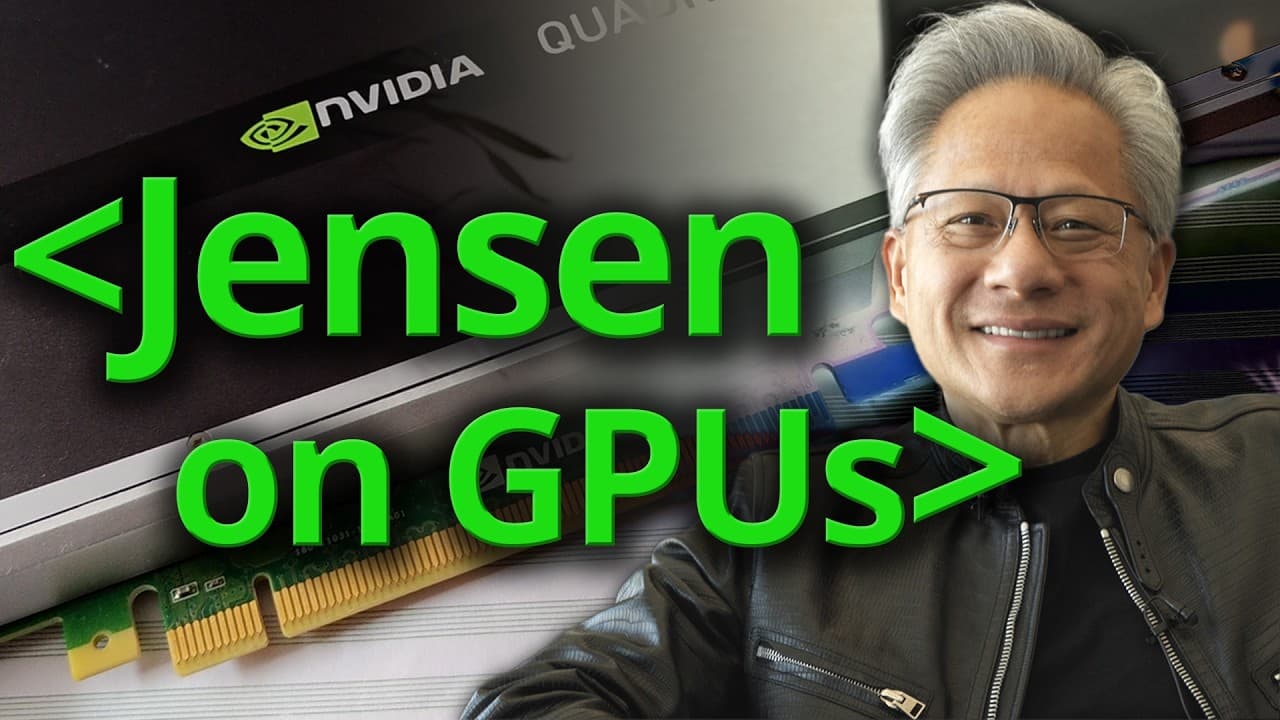
New Video from @Computerphile: Guest Shares Insights on Computing and Technology
In this video, the guest shares his experiences and opinions on various topics related to computing and technology. He begins by discussing his first computers, including an Apple 2 and a teletype connected to a mainframe, before delving into his preferences for keyboard shortcuts and programming, such as using tabs instead of spaces. He also mentions his favorite programming languages, such as Fortran, Pascal, and O, as well as his dislike for C++. The guest then talks about his hobbies, including reading archive papers, and how he uses AI tools like ChatGPT to summarize and understand these documents. He highlights the importance of AI in various fields, including silicon photonics and physical modeling. The discussion then turns to the evolution of GPUs, particularly the differences between Quadro and GeForce cards, and how tensor cores have become essential for AI and graphics applications. A central point of the video is the impact of AI on GPU development. The guest explains how tensor cores, initially designed for data centers, have been integrated into GeForce GPUs, revolutionizing graphic rendering. He also mentions the importance of precision and quantization in AI calculations, allowing for significant improvements in performance and energy efficiency. The video also addresses Moore's Law and how hardware acceleration has allowed it to be surpassed. The guest explains that optimizing software, algorithms, and hardware simultaneously has led to performance gains far beyond what Moore's Law predicted. He also discusses the differences between scale-up and scale-out, the former involving making a processor faster, while the latter involves distributing tasks across multiple processors or nodes. The guest mentions unexpected applications of GPUs, such as base signal processing for 5G radios, and how AI could be integrated to improve spectral efficiency and reduce energy consumption. He concludes by emphasizing the importance of CPUs for sequential tasks and how GPUs are essential for parallelizable tasks. Finally, the guest shares an anecdote about using Nvidia GPUs to calculate the largest prime number, demonstrating the impressive capabilities of these technologies. To learn more, watch the full video at the following address: https://www.youtube.com/watch?v=G6R7UOFx1bw