
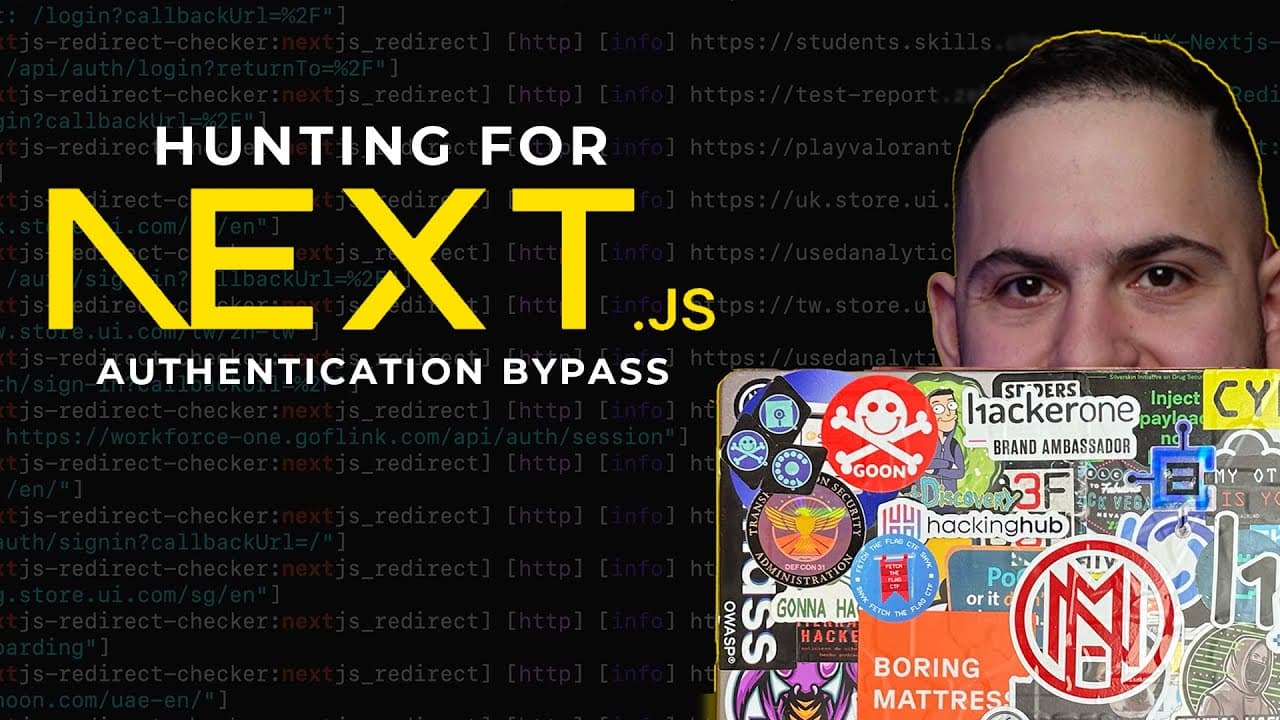
NahamSec Releases New Video on Exploiting Critical Vulnerability CVE-2025-29927 HTTP header
In this video, NahamSec explores the discovery and exploitation of a critical vulnerability, CVE-2025-29927 HTTP header, which affects many web applications. Despite the time that has passed since the vulnerability was disclosed, many companies, including those with significant security teams, have not yet applied a patch. NahamSec shares his large-scale scanning process, exploitation techniques, and the various scenarios encountered. The process begins with using SubFinder to collect subdomains from various sources. Then, NahamSec uses the Axium framework to distribute the scan across 20 low-cost Digital Ocean machines, enabling massive parallel analysis. Once the subdomains are collected, he uses Nuclei to specifically scan for the vulnerability in question. The detection methodology is simple: send a request with the xjs data header and check the responses for a 307 status code and the X nextjs redirect header. For large-scale exploitation, NahamSec uses httpx with a custom payload to cover different scenarios and versions. He also automates the capture of response screenshots to quickly identify accessible dashboards. The exploitation scenarios vary: some allow full access with data modification, others require direct interaction with APIs, and some seem vulnerable but require further verification. NahamSec emphasizes the importance of understanding the vulnerability and the target application. He built a local application in Next.js to better understand the vulnerability, which allowed him to create a functional POC. He recommends reproducing vulnerabilities locally before going bug hunting. The practical implications of this video are numerous. Critical vulnerabilities in popular frameworks can remain unpatched for days, providing opportunities for attackers and bug hunters. Automation is essential, but understanding the specifics of the vulnerability is crucial. Web application firewalls (WAFs) are not always reliable in preventing these attacks. Finally, Next.js is ubiquitous, but exploiting its vulnerabilities requires a deep understanding of authentication and application integration. For those who want to learn more, NahamSec offers a practical lab on hackingup.io and invites viewers to comment "Automation" for a live demonstration of his complete process.