
New Video from @Computerphile Explores Limitations and Innovations in AI
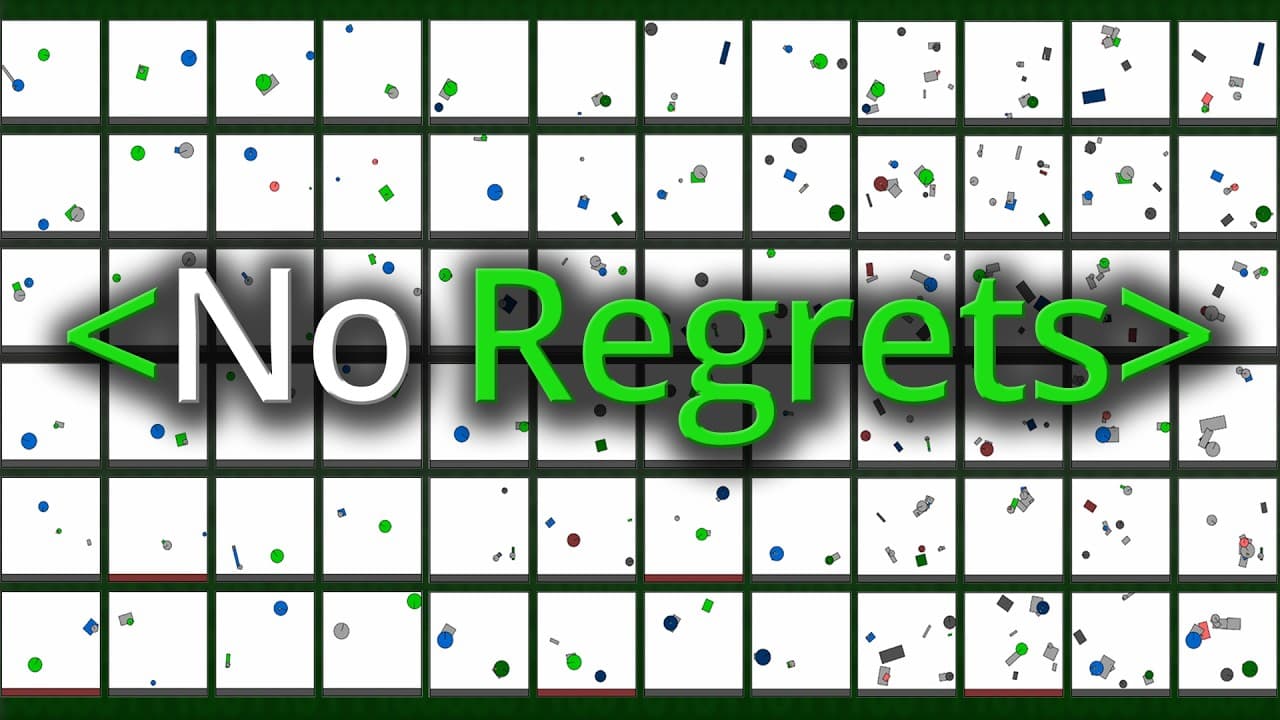
The video explores the current limitations of artificial intelligence (AI) models based on supervised or self-supervised learning, which excel at textual tasks such as question-answering or chatbots but are poorly suited for making complex decisions in the real world. The challenge lies in the need for AI systems to take actions and learn through trial and error, which is risky and requires a large amount of environmental data. To overcome these limitations, the video proposes moving to simulated environments where agents can be trained safely. The idea is to create an "internet of environments" to train models capable of making decisions and planning long-term. This approach relies on the continuous acceleration of computer processing capabilities, enabling the simulation of complex and varied environments. A key concept discussed is "regret," which measures the difference between an agent's performance and the optimal performance in a given environment. The goal is to minimize this regret to ensure the agent learns effectively. However, traditional methods of approximating regret have proven ineffective in more complex environments, such as those involving multiple robots navigating a continuous space. The video then introduces the concept of "learnability," an intuitive measure of an agent's ability to learn in a given environment. Unlike regret approximations, optimizing directly for learnability has led to better performance and generalization in complex test environments. This discovery highlights the importance of rethinking research paradigms and returning to basic principles to solve complex problems. To accelerate research in reinforcement learning, the video presents the initiative "RL at the hyperscale," which involves running both the environment and the agent on the GPU, eliminating communication bottlenecks between the CPU and GPU. This approach has resulted in significant performance gains, making it possible to quickly evaluate numerous environments. Finally, the video introduces "Kinetics," a GPU-accelerated 2D physics simulator that can generate a wide variety of reinforcement learning tasks. This simulator has shown zero-shot improvements and the ability to quickly adapt to new tasks, similar to how pre-trained language models can be fine-tuned for specific tasks. In conclusion, the video highlights the challenges and opportunities in the field of AI, particularly for systems that need to make complex decisions in the real world. It proposes innovative solutions based on simulation and the optimization of learnability, paving the way for more robust and adaptable agents.