
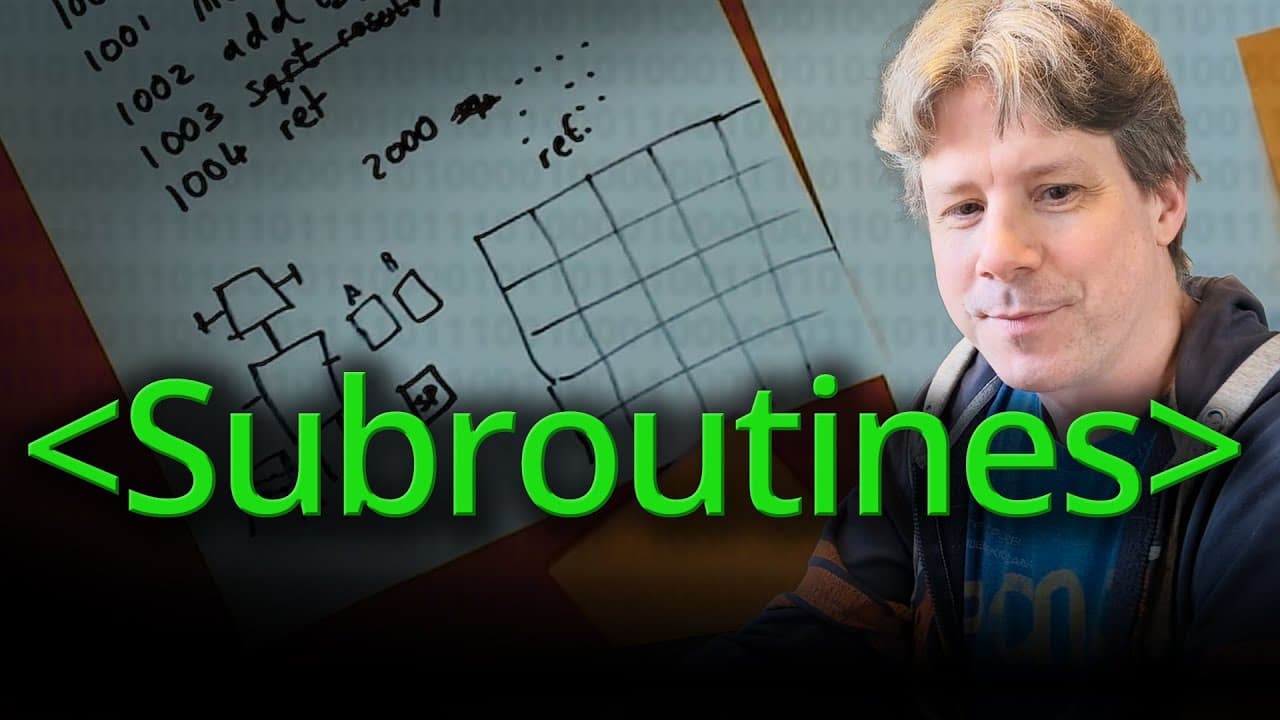
New Video from @Computerphile Explores Building Complex Programs
In this video, the presenter explores how to build more complex programs than those previously demonstrated using his fictional paper and pencil-based computer. He begins by recalling the operation of his small robot and its pigeonhole array representing memory and the CPU. Each pigeonhole is numbered and contains data or instructions, while the robot has a few temporary registers to perform simple operations like addition. The presenter then explains how instructions can be encoded into numbers and stored in the pigeonholes, allowing an elegant combination of storage for both data and the program itself. However, he acknowledges that this method becomes complex for more significant programs. To overcome this difficulty, he introduces the concept of reusing pieces of code, known as subroutines or functions. To illustrate this, he writes a small piece of code to calculate the magnitude of a vector in a 2D game. This code uses instructions like "multiply" and "add" to calculate x^2 + y^2, then takes the square root of the result. He shows how this code can be stored at a specific memory address and reused multiple times using the "call" instruction. This instruction allows jumping to the subroutine's address, executing the code, and then returning to the next instruction of the main program using the "return" instruction. The presenter then introduces the concept of a stack to manage nested function calls. The stack is a simple data structure that allows storing and retrieving values in the reverse order of their addition. He explains how the CPU uses a register called the stack pointer to manage this structure. When a function is called, the return address is pushed onto the stack, and when the function ends, this address is popped from the stack to return to the next instruction. He demonstrates this mechanism by rewriting the Fibonacci sequence program recursively. He introduces a calling convention to define how functions interact with registers, specifying which registers can be used temporarily and which must be preserved. This convention helps avoid conflicts and ensures that functions can be reliably reused. The presenter also explains the security implications of stack overflows, which can occur if the stack is not managed correctly. He mentions that modern operating systems have protections to avoid these issues, but bugs can still occur if programmers do not pay attention to the balance between push and pop operations. Finally, he uses a tool called Compiler Explorer to show how a program written in a high-level language like C is compiled into assembly instructions. He compares the code generated by the compiler with the code he wrote by hand, showing that the discussed concepts are fundamental and applicable in real scenarios. In conclusion, this video provides an in-depth understanding of how complex programs are built and managed at the CPU level, using concepts like subroutines, stacks, and calling conventions. These concepts are essential for understanding the internal workings of computers and for writing efficient and secure programs.