
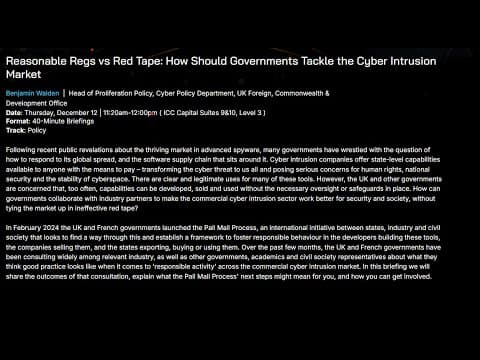
New Video from @BlackHatOfficialYT Discusses Cyber Intrusion Capabilities and the Palm Process
In this video, Elizabeth Davis and Ben Walden from the UK Foreign Commonwealth and Development Office (FCDO) discuss the commercial proliferation of cyber intrusion capabilities and the international initiative known as the Palm process. They explain the UK government's concerns about this proliferation and the measures being considered to address it. The main topics covered include the definition of commercial cyber intrusion capabilities proliferation, the types of associated threats, and the implications for national and international security. Davis and Walden highlight that this proliferation includes hacking-as-a-service companies, the market for vulnerabilities and exploits, hacker groups for hire, and the misuse of modular tools. Although these tools have legitimate uses, their misuse increases threats and compromises critical infrastructure, businesses, and citizens. A crucial point is the opacity of the market, which complicates attribution of responsibility and the implementation of effective security measures. The UK's National Cyber Security Center (NCSC) has assessed that the growing demand for these capabilities, coupled with a permissive operational environment, will likely increase the threat over the next five years. This expansion could be transformative for cyber threats if no intervention is put in place. The Palm process, launched by the UK and France, aims to address these issues globally. The goal is to control and limit access to the most advanced capabilities, encourage the responsible development, sale, and use of these capabilities, and improve market transparency. Davis and Walden explain that this requires collaboration between states, companies, and threat researchers. They also mention the importance of international standards and accountability mechanisms to encourage responsible behavior. Among the recommendations for governments are the need to define clear standards for regulating cyber intrusion capabilities, establish independent oversight, and reconsider export control regimes. For companies, it is recommended to publish relationship management processes, improve customer knowledge requirements, manage vulnerabilities responsibly, and enhance supply chain transparency. The practical implications of these discussions are vast. By improving transparency and encouraging responsible behaviors, governments and companies can reduce cyber threats and protect critical infrastructure. This requires a harmonized approach and incentives to encourage responsible practices. In conclusion, the video highlights the complex challenges posed by the commercial proliferation of cyber intrusion capabilities and the international efforts to address them. It provides valuable insights into the necessary measures to secure cyberspace and protect national and international interests.