
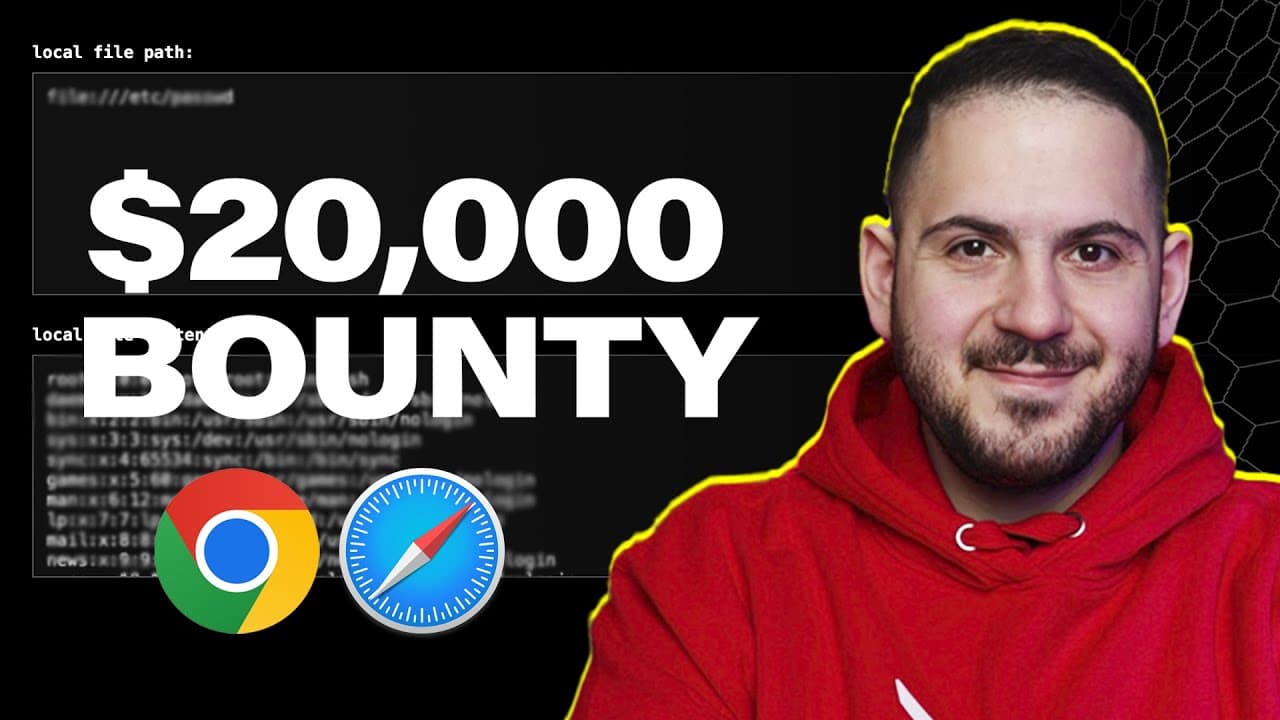
NahamSec Releases New Video on Chrome Vulnerabilities
In this video, NahamSec explores a lesser-known aspect of web browsers like Chrome: their background use in various devices and applications. He begins by highlighting that Chrome is not only used for checking emails or watching videos but also for generating PDFs, powering the user interfaces of e-readers, and much more. This extended use means that Chrome's vulnerabilities can affect more than just your browser tabs. A concrete example is given with the vulnerability CVE-2023-4357, an XXE (XML External Entity) flaw that allows an attacker to read local files on the server or machine running Chrome. NahamSec explains that although this vulnerability has been known for over a year, it remains relevant because it can still be present in devices and applications where Chrome is integrated and often forgotten, such as smart screens, Electron applications, and embedded systems. The video then focuses on a practical demonstration of exploiting this vulnerability. NahamSec shows how to identify the version of Chrome running in the background, a crucial step in determining if the vulnerability can be exploited. He uses a prepared script to exploit the XXE flaw via SVGs (Scalable Vector Graphics), which are images written in XML. By injecting a malicious XML file, he manages to read the contents of a local file, such as /etc/passwd, and display it in a text area. To go further, NahamSec explains how to exfiltrate this sensitive data to a server controlled by the attacker, even if the exploit works blindly or on a device. He emphasizes the importance of this step to retrieve stolen information, especially in contexts where direct display is not possible. The video also addresses the financial implications of discovering such vulnerabilities. NahamSec shares his experience of receiving a $20,000 reward for exploiting this flaw on a specific device. He stresses the importance of thinking creatively to inject malicious content into environments where Chrome is integrated, such as Electron applications or smart devices. Finally, NahamSec encourages viewers to explore these vulnerabilities in various contexts, emphasizing that even if a flaw is old, it can still be exploitable in less frequently updated systems. He invites viewers to subscribe and leave comments to encourage the creation of more similar content.