
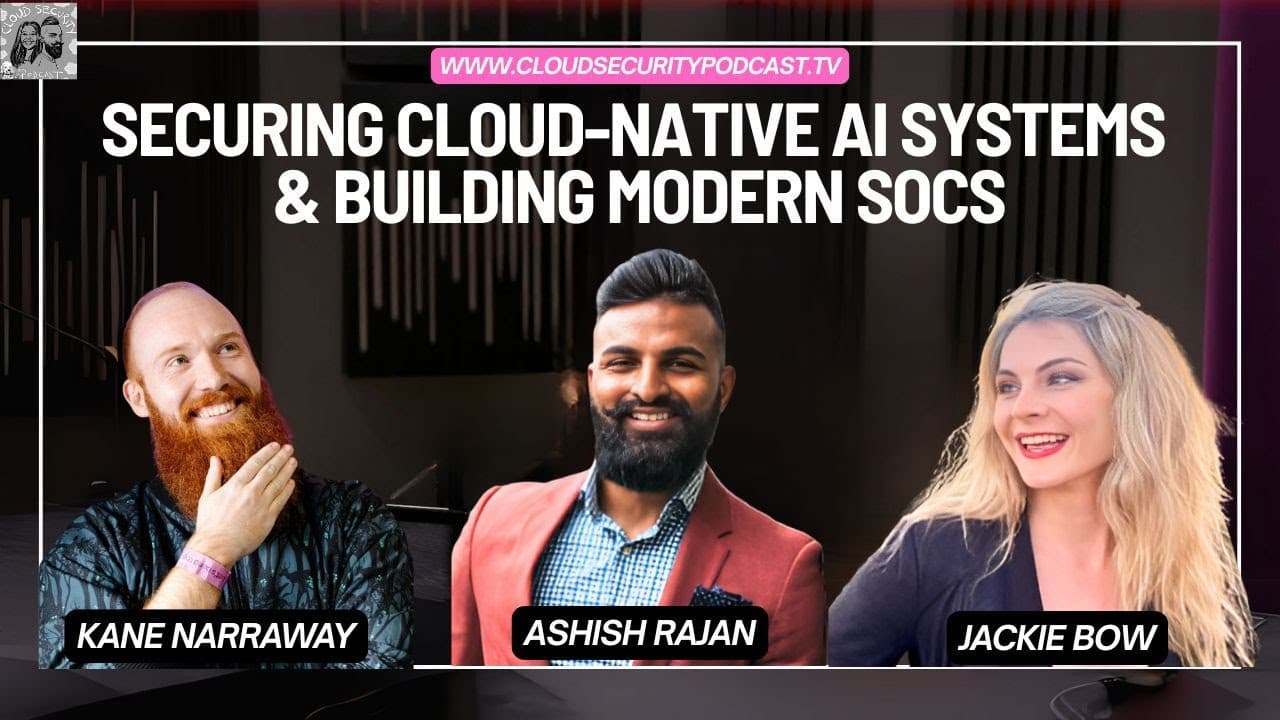
New Video from @CloudSecurityPodcast: Experts Discuss AI Integration in Security Operations
In this new video from @CloudSecurityPodcast, cybersecurity experts Jackie Bo and Kane discuss the challenges and opportunities associated with integrating artificial intelligence (AI) into security operations. The discussion is moderated by Dana Torus, Vice President of Product Marketing at Armor Code, and takes place as part of the Bsides SF conference. Main topics discussed: 1. Evolution of security operations: Jackie Bo, Technical Lead of the Threat Detection Engineering Platform at Anthropic, explains how threat detection and response operations have evolved. Traditionally, security teams used monolithic tools like SIEM (Security Information and Event Management). However, the introduction of AI has transformed these operations, although early attempts were often disappointing due to numerous false positives. 2. Risks associated with AI systems: Kane, Head of Enterprise Security at Canva, highlights that AI service providers face specific risks that go beyond traditional software-as-a-service (SaaS) risks. These risks include increased attack surfaces and additional efforts required to secure these systems. 3. Using AI for detection and response: Jackie Bo shares her experience with Claude, a coding agent from Anthropic, which helps automate and improve detection and response processes. She explains how Claude can be used to create detection signatures and sort alerts, thereby reducing the workload of security teams. 4. Threat modeling for AI systems: Kane discusses the importance of threat modeling for AI systems. He emphasizes the importance of focusing on access and integrations, as these are often the most vulnerable points. He also mentions the challenges related to authorization and authentication in AI systems. Key insights: - Controlled hallucinations: Jackie Bo introduces the concept of controlled hallucinations, where AI is encouraged to propose creative solutions while being guided to avoid errors. This can help discover innovative ideas that would not have been considered otherwise. - Threat modeling: Kane points out that threat modeling for AI systems is not fundamentally different from that for traditional systems. However, the focus should be on integrations and authorizations, as these are often the weak points. - Scalability and rapid prototyping: AI enables quick prototyping and testing of new ideas, which can significantly accelerate the development of security solutions. Technical details: - MCP (Multi-Agent Collaboration Protocol): Kane explains that MCP is an open standard for writing connectors that can be provided to AI agents. This allows AI to perform actions it couldn't otherwise, such as interacting with specific APIs. - Claude Code: Jackie Bo describes Claude Code as a collaborative coding agent that can help automate security tasks, such as creating detection signatures and sorting alerts. Practical implications: For security professionals, integrating AI offers many opportunities to improve the efficiency and accuracy of detection and response operations. However, it is crucial to understand the associated risks and implement appropriate security measures. Security teams must also be prepared to adapt their skills and tools to fully leverage AI capabilities. In conclusion, this video provides an in-depth look at the challenges and opportunities associated with integrating AI into security operations. It highlights the importance of innovation and adaptation in a constantly evolving field.