
Expert Discusses OpenAI and Anthropic's Pursuit of Superintelligence
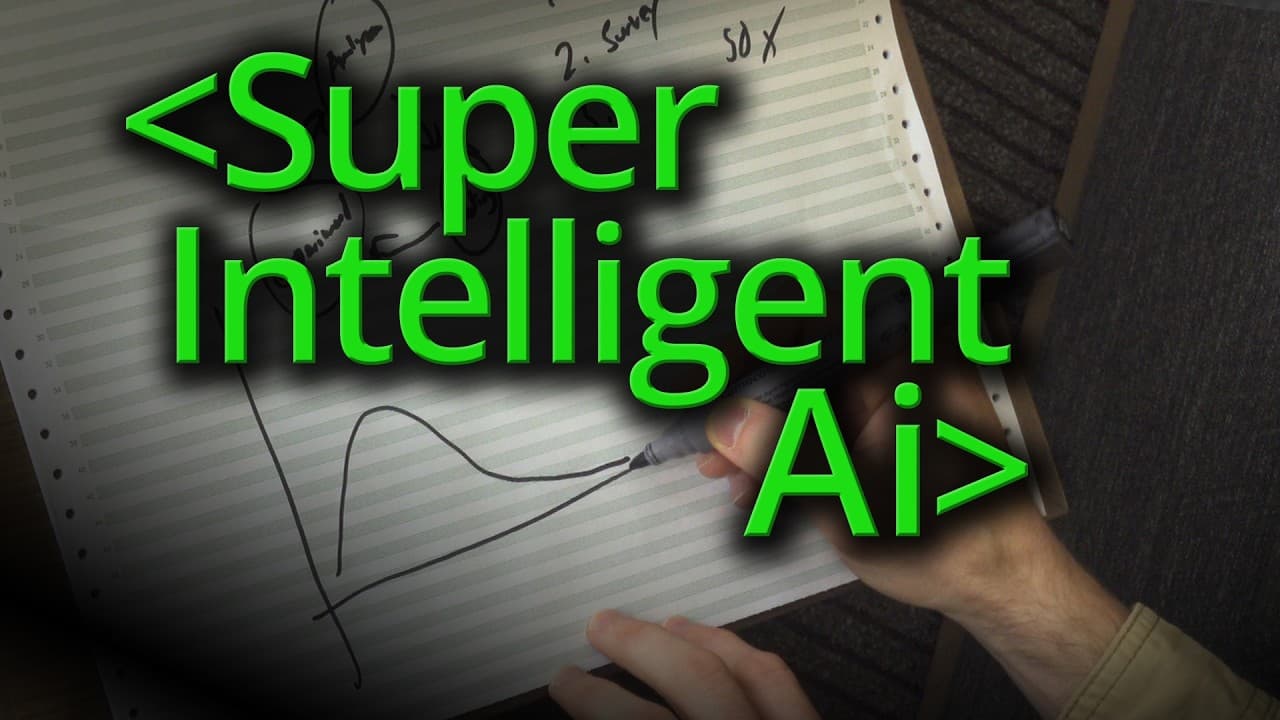
In this video, an expert discusses the efforts of OpenAI and Anthropic to develop a superintelligence, an artificial intelligence (AI) that surpasses the best humans in all fields. The expert works for the Data Futures Project, a small non-profit organization that aims to predict the evolution of AI. According to them, it is likely that these companies will succeed in achieving superintelligence by the end of this decade. The expert explains that the term "superintelligence" refers to an AI that is better than the best humans in absolutely everything, unlike artificial general intelligence (AGI), which can have different definitions. He emphasizes that, somewhere between the current level of AI and superintelligence, companies will be able to automate the AI research process itself. This means that autonomous AIs will be able to conduct experiments, analyze results, and choose the next experiments, thus accelerating the pace of AI progress. The expert presents a fictional scenario where, by 2027, companies could have 100,000 parallel copies of AI operating at a speed 50 times faster than humans. These AIs could interact, write code, test, and learn from experiments, while using only 1% of the world's relevant computing power for AI. This would still leave a large portion of computing power available for other tasks. The expert then explores different stages of automating AI research and their potential impact on the speed of progress. He estimates that, even if AIs are only capable of coding at a superhuman level, this could already accelerate progress by 5 times. If AIs can also analyze the results of experiments, the speed could be multiplied by 200. Surveys of AI researchers suggest that, if each employee had a digital twin thinking 30 times faster, companies could go 12 to 120 times faster. The expert also introduces the concept of "research taste," which refers to the ability to choose the right experiments and learn from them effectively. He argues that, even if AIs are limited by computing power for experiments, better "research taste" could allow for better use of this computing power, further accelerating progress. In conclusion, the expert estimates that, when AIs reach the level of the best human AI researchers, the speed of algorithmic progress could be 25 to 50 times faster than today. However, he emphasizes that there are great uncertainties and these estimates could be incorrect. To learn more, watch the full video at the following address: https://www.youtube.com/watch?v=5UAvECavmFA