
New Video from @Computerphile Explores Reinforcement Learning
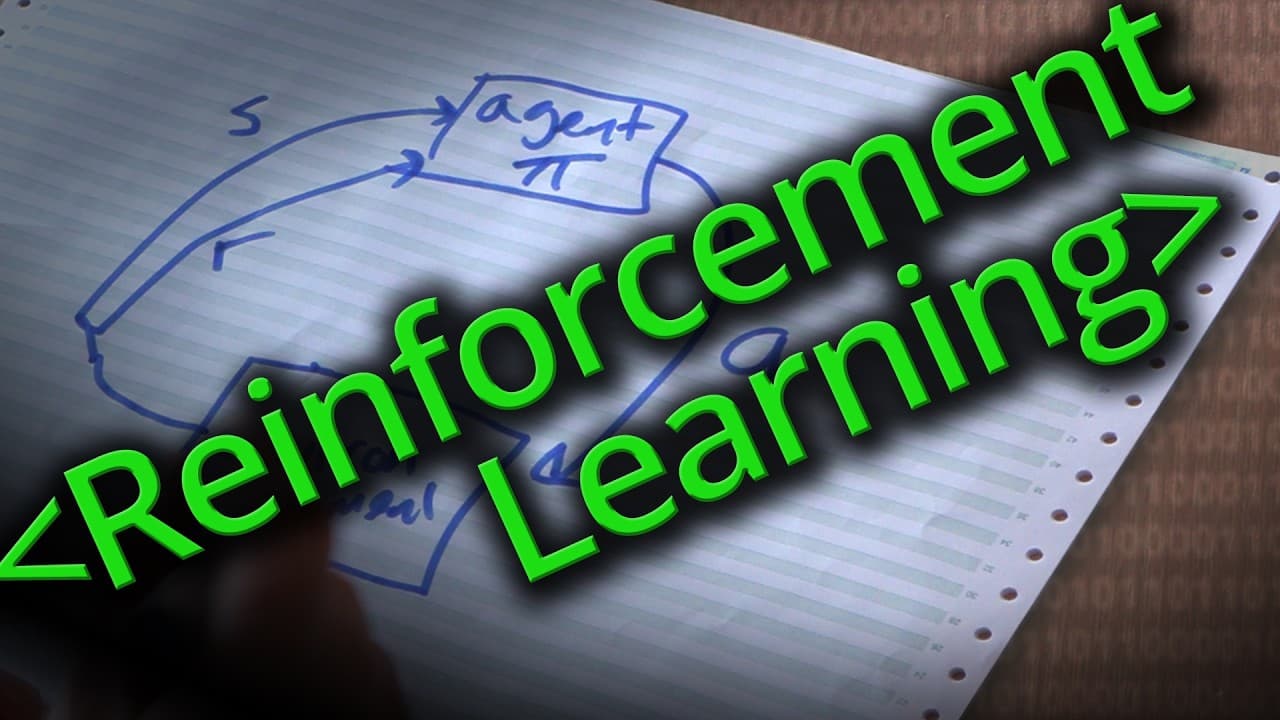
The video explores the use of reinforcement learning, an artificial intelligence technique, to solve decision-making problems similar to those addressed in previous videos. Reinforcement learning is a key branch of machine learning, alongside supervised and unsupervised learning. Unlike supervised learning, where correct answers are available, reinforcement learning relies on reward signals that indicate the quality of the actions taken. In the context of the example of the home-to-work journey, travel time is used as a reward signal. The goal is to maximize this reward, which means minimizing travel time or arriving at work as early as possible. Unlike other techniques such as Monte Carlo tree search, reinforcement learning does not use a simulator to anticipate actions. Instead, the agent acts directly in the real environment and adjusts its future actions based on the rewards obtained. The central concept of reinforcement learning is the agent using a policy to choose actions. The environment executes these actions and provides rewards and subsequent states to the agent. This process is often represented by the Q-function, which evaluates the cost of actions in different states. Tabular reinforcement learning, where all states and actions can be enumerated, is a simple method to understand this process. A major challenge in reinforcement learning is the balance between exploration and exploitation. Exploration involves trying new actions to discover better options, while exploitation involves choosing actions already known to be effective. An epsilon-greedy policy is often used to balance these two aspects. With a probability of epsilon, the agent explores new actions, while with a probability of 1-epsilon, it exploits the actions known to be the best. The video illustrates this process with an example of a home-to-work journey, where the agent chooses actions such as taking the car or the train, and receives rewards based on travel time. The Q-values are updated based on the rewards obtained, and the policy is adjusted to maximize these values. However, a limitation of this method is that the agent continues to explore even after finding a good policy, which can be inefficient. More advanced algorithms, such as off-policy reinforcement learning, are developed to overcome this limitation. In summary, reinforcement learning is a powerful technique for solving decision-making problems by learning directly from the real environment. Although simple in its basic concepts, it offers many variations and complexities that are actively explored in research and practical applications.