
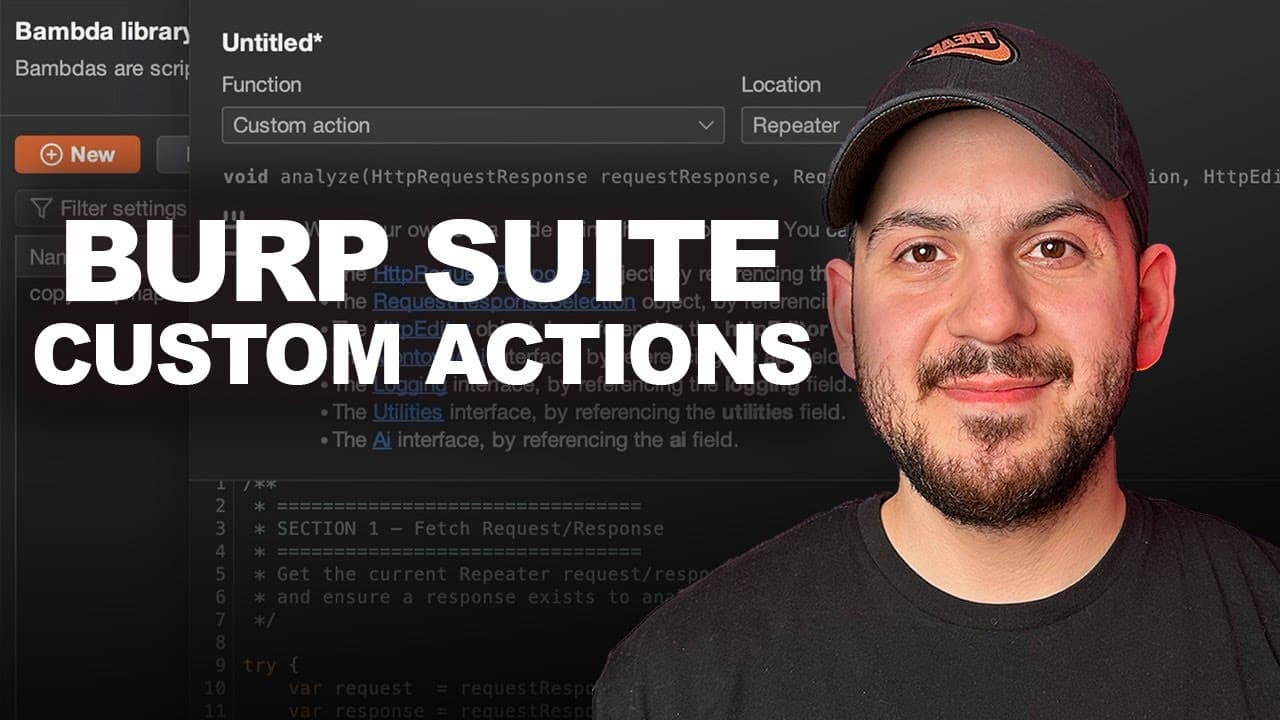
NahamSec Explores Burp Suite Actions for Automating Web Security Tasks
In this video, NahamSec explores a recent feature of Burp Suite called Burp Suite Actions, which allows users to create custom mini-tools to automate and optimize their web security tasks. The central idea is to show how these actions can solve real problems for bug hunters, rather than just adding superfluous features. NahamSec shares two practical examples he developed to illustrate the utility of these actions, emphasizing efficiency and workflow simplification.
The first example presented is a tool called Reflector Detector, designed to analyze reflection points in HTTP responses. This script automates the detection of places where user input (such as a parameter in a URL) is reflected in the server's response, identifying the exact context: is it in a script tag, an HTML attribute, or elsewhere? For a bug hunter, this is particularly useful for spotting vulnerabilities like XSS (Cross-Site Scripting), where knowledge of the reflection context is crucial for exploiting the flaw. Instead of manually searching for each parameter in the source code with browser developer tools, this tool saves valuable time by automatically analyzing responses and providing a clear report. NahamSec demonstrates how the tool works by applying it to several requests in Burp Repeater, where it instantly detects reflection points and their context, facilitating the identification of potential attack vectors.
The second example addresses a common problem for pentesters and bug hunters: managing requests between Burp Suite and external tools like SQLmap, fuzzers, or even AI wrappers. NahamSec presents a custom action called Copy to SQLmap, which automatically extracts an intercepted request in Burp and generates a ready-to-use command for SQLmap. This avoids manually copying the request, pasting it into a file, and then constructing the SQLmap command by hand. The tool creates a temporary file containing the request and generates the complete command, including options like a random user agent. NahamSec illustrates this by testing an SQL injection on a vulnerable lab, showing how the tool speeds up the detection process. He also highlights that this principle can be adapted to other tools, such as fuzzers (FFUF) or subdomain scanners, by simply modifying the generated command. To demonstrate this flexibility, he improvises a live adaptation of the tool for FFUF, although this requires some syntax adjustments, showing how customizable these actions can be.
Beyond the technical examples, NahamSec emphasizes the importance of thinking about real problems these actions can solve. Rather than creating tools "for fun," he encourages viewers to identify repetitive or tedious tasks in their workflow and automate them with custom actions. He challenges the community to come up with other creative use cases for these actions, such as integration with vulnerability analysis tools or exploitation scripts. This semi-automated approach allows combining the power of Burp Suite with the efficiency of external tools while maintaining manual control over critical steps. For those who wish to replicate these examples, NahamSec notes that all the code will be available on his GitHub, although he warns that these scripts were developed quickly and may require adjustments.
In conclusion, this video highlights an often underestimated feature of Burp Suite, offering cybersecurity professionals a powerful way to customize their work environment. Whether accelerating vulnerability detection or streamlining interactions between Burp and other tools, Burp Suite Actions open the door to numerous possibilities. NahamSec ends by inviting viewers to share their ideas and subscribe for more content of this type, emphasizing the importance of innovation and efficiency in bug hunting.